Beginning Again
A woman from Poland arrives in Cyprus carrying a broken heart and a life she no longer recognises as her own. Through collage and painting, she traces the slow, deliberate process of rebuilding: not the life she left, but herself. What begins as an act of survival becomes, step by step, an act of love.
STORIES FROM CYPRUS
6/14/20262 min read
She did not arrive in Cyprus with a plan. She arrived with a wound.
The breakup had left behind more than absence. It had left behind a version of herself she no longer knew how to locate: her own certainty, her own clarity, her own sense of where she ended and where someone else began. The questions that followed her were not abstract. They were daily. They arrived in the morning before she was ready for them. They accompanied her through unfamiliar streets in a country she had not yet learned to read. They sat with her in the silence that comes when a life has been rearranged too quickly and the new shape has not yet declared itself.
Madalena is from Poland. She carried with her, as people do, everything that had formed her before the crossing: the particular texture of a Polish childhood, the weight of winters that teach endurance, the family patterns that shape a woman's understanding of what she owes to herself and what she owes to others. She also carried the specific grief of a relationship that had ended, a grief that is rarely simple because it is never only about the other person. It is also about the self that was built inside that relationship and now has to be rebuilt outside it.
The decision she made was conscious. This matters. She did not simply move through the pain. She turned toward it.
To face everything she was feeling required a kind of courage that does not look dramatic from the outside. It looked like getting up. It looked like asking herself honest questions. It looked like resisting the instinct to fill the emptiness quickly with anything that would make it feel smaller. She chose instead to sit with the discomfort long enough to understand what it was telling her. And slowly, without a single moment of resolution, she began to find herself again.
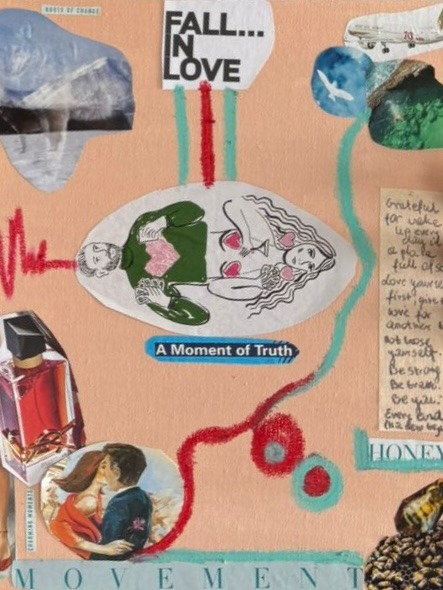
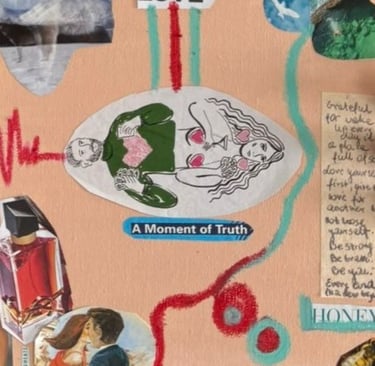
She worked with collage and painting, and the combination is telling. Collage requires gathering: selecting fragments, deciding what belongs, making meaning from pieces that did not start out together. Painting requires presence: the hand moving directly on the surface, no mediation, no distance. Together they gave her a process that matched what she was doing internally: assembling a new understanding of herself from what remained after the rupture, and then filling it in with colour, with intention, with her own direct mark.
Cyprus entered her story not as backdrop but as participant. Its warmth was not incidental. For someone rebuilding her relationship with herself, an environment that offered openness, light, and the particular generosity of a small island community became part of the material she was working with. She fell in love with it, she says, and the phrase carries its full meaning. To fall in love with a place is to allow yourself to be affected by it, to let it matter, to stop protecting yourself from the risk of caring. It was, for her, evidence of recovery: the capacity to feel something new, something forward-facing, something that belonged entirely to who she was becoming.
And then, more quietly, she fell in love with herself.
Not as a conclusion. Not as the ending of a difficult chapter. But as something real and grounded: a relationship with her own worth that had been earned through the process of not looking away. The collage and the paintings she made through HERS are not illustrations of this story. They are the places where the story happened. Where she cut and placed and painted and, in doing so, learned again that she was someone worth returning to.
HERS
Funded by the European Union. Views and opinions expressed are however those of the author(s) only and do not necessarily reflect those of the European Union or the European Education and Culture Executive Agency (EACEA). Neither the European Union nor EACEA can be held responsible for them.
Contact
hers@odyssea.com
© 2024. All rights reserved.