Learning to Protect the Light
A woman from Lebanon steps into an unfamiliar country carrying grief, uncertainty, and an open heart. Through painting, she traces the education that migration delivered not through books or language classes, but through people: those who proved trustworthy and those who did not. What she gains, in the end, is not hardness but wisdom.
STORIES FROM CYPRUS
6/14/20262 min read
Through the HERS process, painting gave Moon a surface on which to lay all of this down. To externalise what had been carried internally. To look at the phases of her journey not as a sequence of wounds but as a curriculum: one she had not signed up for, but one that had taught her things she could not have learned any other way. She is wiser now. She is more careful now. And she is still kind, deliberately, consciously, as an act of choice rather than an act of naivety.
That, she would say, is the difference.
Leaving Lebanon was not a choice she made lightly. The moment of departure carried everything that such moments carry: the weight of what is left behind, the strangeness of what lies ahead, and the particular sadness of a life interrupted before it had finished saying what it needed to say. The country she arrived in was unfamiliar in ways that went beyond geography. The sounds were different. The social codes were different. The air itself seemed to carry a different kind of silence.
In those early weeks and months, Moon moved through her new surroundings carefully, as people do when they are still learning where the edges are. The sadness she felt was not dramatic. It was quiet and persistent, the kind that settles into ordinary moments: a meal eaten alone, a street that does not yet feel like hers, the absence of faces she has known long enough to trust without thinking about it. Alongside the sadness came uncertainty, and beneath the uncertainty, a fear she did not always name but always felt. The fear of not understanding. The fear of belonging nowhere. The fear that the life she was trying to build might not hold.
She kept her heart open. This was, at first, simply who she was.
But the education that migration delivered came not only through systems and languages and the bureaucracy of starting over. It came through people. And people, she learned, are not always what they appear to be. She encountered warmth that was genuine and warmth that was performed. She encountered trust that was well-placed and trust that was used against her. She sat across from smiles that did not extend to what was said when she was no longer in the room. These experiences hurt in a specific way, the way betrayal hurts when you are already vulnerable: sharply, and with a particular kind of loneliness that is different from ordinary loneliness because it confirms a fear you had been trying not to have.
She did not become closed. This matters.
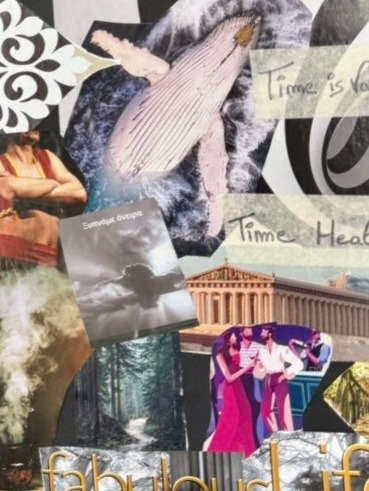
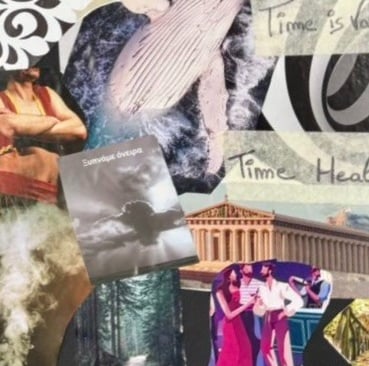
What she developed instead was discernment. The understanding that kindness is a strength and not a weakness, but that distributing it without care is a different thing entirely. She learned to notice more carefully: the gap between what people said and how they behaved, the difference between those who offered genuine connection and those who offered only the appearance of it. She learned to protect her energy, not because the world had made her cynical, but because experience had made her clear.
Her painting holds this journey without bitterness. It traces the arc from the raw vulnerability of arrival, through the difficult middle passage of broken trust and recalibrated expectations, to the steadier ground she now stands on. The work does not celebrate suffering. It honours the learning that came from it.
HERS
Funded by the European Union. Views and opinions expressed are however those of the author(s) only and do not necessarily reflect those of the European Union or the European Education and Culture Executive Agency (EACEA). Neither the European Union nor EACEA can be held responsible for them.
Contact
hers@odyssea.com
© 2024. All rights reserved.