
Shattered Road
A woman from Iran charts her migration as a road drawn across a graph, with cars in every state of wholeness and ruin scattered along it. From a life in Iran that had become a burden, through Turkey and Poland, to the rocky shore of Cyprus, Tahmine's collage traces a shattered road that nonetheless arrives somewhere beautiful, carried the whole way by a resilience she names as her inheritance.
STORIES FROM CYPRUS
6/15/20262 min read
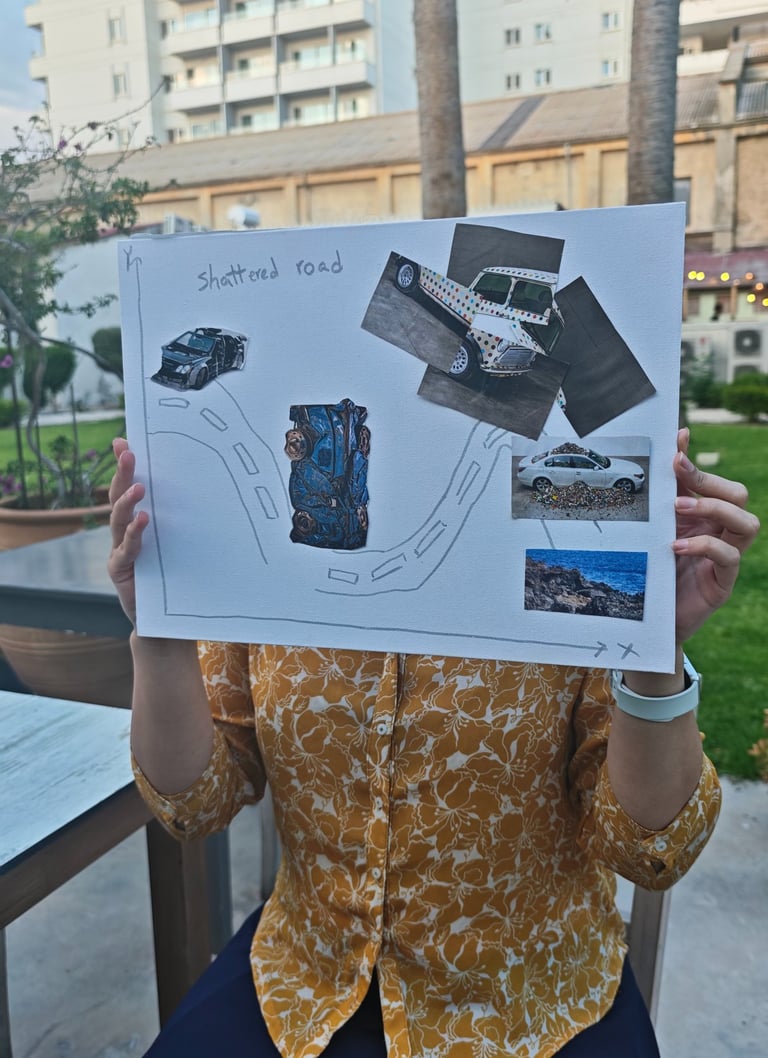
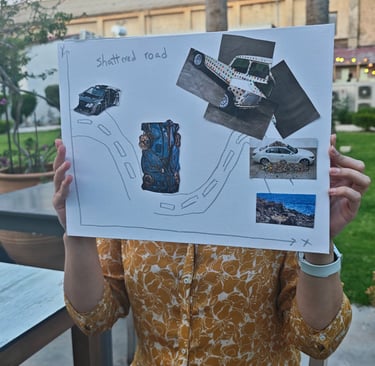
She drew the axes first. A vertical line, a horizontal line, arrows pointing up and outward, the framework of a graph. This is how Tahmine sees her journey, as a trajectory plotted across time and distance, and she titled it with unflinching honesty: Shattered Road.
Along that road she placed the cars. This is not accidental. Cars run through her story from the beginning, from a life in Iran where she moved between industry and academia, where the road was a familiar thing. But on her page the cars are in every condition. One still intact and gleaming. One painted over in bright dots, almost playful. And then, at the centre, the truth of it: a car crushed and compacted into a ruin of blue metal, and another buried in a heap of broken glass. The road between them is cracked into dark fragments. This is what the journey felt like from the inside. A path that kept breaking apart beneath her.
Then her husband said the words that redrew the map. Let's go to Cyprus. There was a passage through Poland, six months, and then, in January 2026, the island.
At the very end of her road, in the corner where the arrow finally points, she placed a photograph of the Cypriot coast. Rock and sea. Beautiful and nice, she says, and she means it plainly, even as she admits she sometimes does not fully know why she is here in Larnaca. But she is here now, by the water, getting connected again through simple things, one daily act at a time. The same resilience that sent her back for bread in Turkey is the resilience building her life in Cyprus. Her collage does not hide the wreckage. It maps it. And it lets the shattered road run all the way to the sea.
The hardest stretch was the middle. She left Iran, where life had come to feel like a burden, like living inside a war, and she went first to Turkey. There she felt like a newborn, unable to communicate, disconnected from the life around her, navigating immigration rules that seemed to change by the day. And here she tells the detail that holds her whole story together. In those early days she went out only to buy bread. Every day, the same small errand, the same shop. At first she was a stranger, unaccepted, met with the wariness reserved for someone who does not belong. But she kept going back. And the day she asked for the bread in Turkish, something shifted. They accepted her. The language was the key that turned in the lock.
This, she says, is her intangible cultural heritage: resilience itself. Not an object or a craft, but the deep, learned capacity to keep going back, to keep trying, to keep showing up at the same shop until the door finally opens. It is what she carried out of Iran when she could carry almost nothing else. The willingness to return, again and again, until a foreign place becomes a little less foreign. That stubborn, patient strength is her inheritance, passed down and carried across every border.
HERS
Funded by the European Union. Views and opinions expressed are however those of the author(s) only and do not necessarily reflect those of the European Union or the European Education and Culture Executive Agency (EACEA). Neither the European Union nor EACEA can be held responsible for them.
Contact
hers@odyssea.com
© 2024. All rights reserved.