
The Weight of the Peaks
Inspired by the mountains of Ukraine, O.’s painting reflects a life shaped by struggle, displacement, and resilience. Through dark landscapes, fractured lines, and a single upward movement toward light, her artwork tells the story of a woman and a family learning to carry hope through uncertainty.
STORIES FROM GREECE
6/13/20262 min read
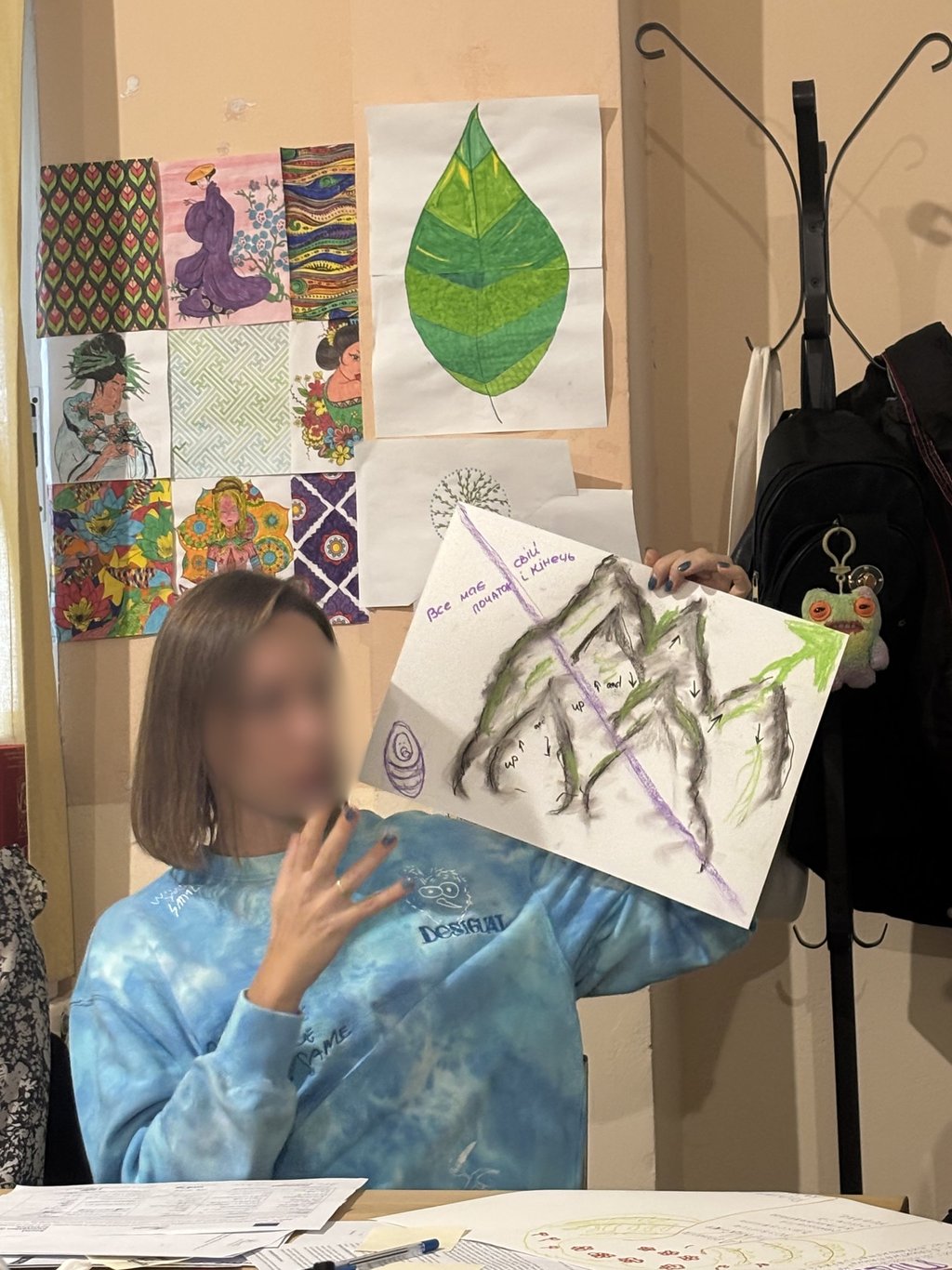
At the bottom left of the painting, a screaming baby emerges. This detail transforms the work completely. The cry is impossible to ignore. It represents fear, vulnerability, and the unbearable emotional intensity of war experienced not only by adults, but by entire families. Yet the child also symbolizes life continuing despite everything. The scream is not silence or surrender; it is presence. It is the insistence of life demanding to be heard.
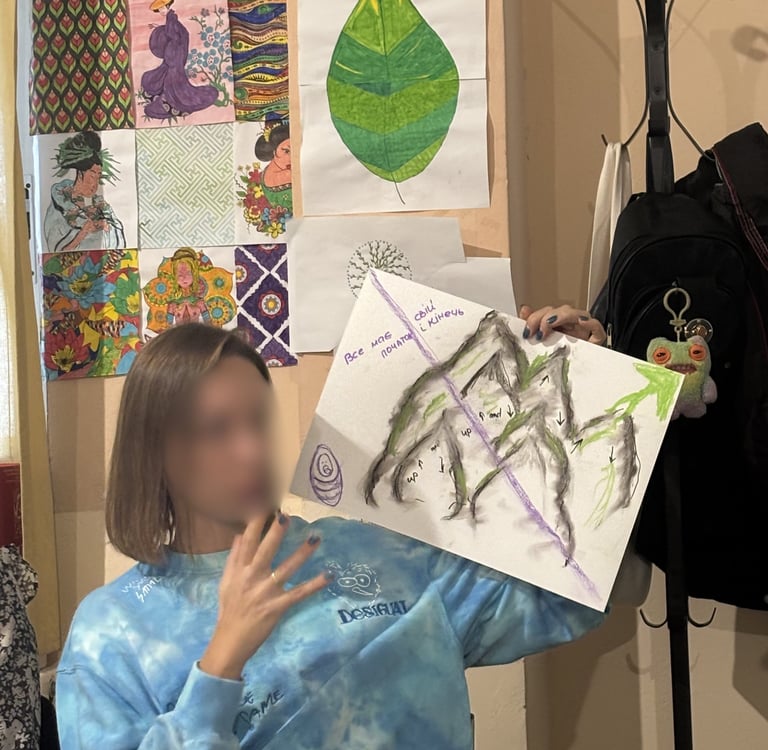
Near the top right corner, one of the only bright elements interrupts the darkness: an arrow moving upward. It introduces another possibility into the painting. After the mountains, after the rupture, after the fear, there remains the idea of movement toward something better. The arrow does not erase suffering, but it refuses to let suffering become the end of the story.
O.’s painting is filled with movement, even in its stillness. Dark mountains rise across the surface, heavy and uneven, surrounding the viewer with a sense of distance and difficulty. Inspired by the landscapes of Ukraine, these mountains are not only places from memory; they become metaphors for the journey of her life. For O., existence itself has felt like climbing: moments of ascent followed by sudden falls, stretches of exhaustion interrupted by the fragile possibility of hope.
The darkness dominating the painting immediately evokes the shadow left by war and displacement. The invasion of Ukraine shaped not only her personal story, but also the emotional world of her family. In the mountains, one can sense fear, instability, and the weight of leaving behind a life that once felt permanent. Like many women forced to rebuild their lives elsewhere, O. carries memories that are both deeply painful and impossible to abandon. The mountains hold these memories like silent witnesses.
Across the painting runs a diagonal purple line, cutting through the composition with tension and direction. It feels like a rupture, a crossing between one life and another. At the same time, it suggests movement forward, as if the story cannot remain trapped in darkness forever. The line divides but also connects, linking past and present, homeland and displacement, grief and endurance. Purple itself carries an emotional ambiguity: it is the color of bruises and sorrow, but also of dignity, imagination, and transformation. In O.’s story, it becomes the trace of survival moving through uncertainty.
HERS
Funded by the European Union. Views and opinions expressed are however those of the author(s) only and do not necessarily reflect those of the European Union or the European Education and Culture Executive Agency (EACEA). Neither the European Union nor EACEA can be held responsible for them.
Contact
hers@odyssea.com
© 2024. All rights reserved.