What She Could Carry
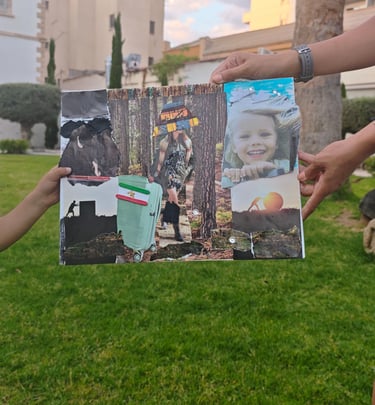
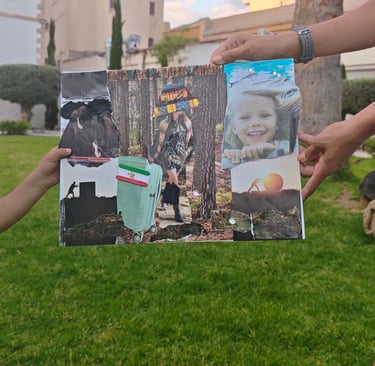
A woman from Iran, ten months a refugee in Cyprus, tells her story through a collage of a single figure walking out of darkness through a forest, pulling a suitcase painted in the colours of her homeland. Around her, figures strain to push against the impossible, and a child smiles into the light. Elham left behind a big home and a normal life and carried what she could, and what she could carry was hope.
STORIES FROM CYPRUS
6/15/20262 min read
And then, in the upper corner, the image that broke the room open. A child, blonde and laughing, lit by an open sky. Pure, uncomplicated joy. It sits above all the darkness and the pushing like a promise. It is the happiness she is reaching for, the future she allows herself to imagine, the innocence and lightness that survived everything and waits on the other side of the struggle.
She says it plainly. In Iran, her life changed. But here, she can look toward a better future. To imagine a future at all, after what she has carried, is its own quiet act of courage. Her collage holds the darkness she walked out of, the weight she pushed against, the flag she could not leave behind, and the child's bright face that tells her it was worth it. Ten months in, still walking through the forest, she has not put the suitcase down. But she has lifted her eyes toward the light.
At the centre of her collage, a woman walks. She moves through a forest of tall pines, alone, carrying her belongings, going forward because there is nowhere else to go. And beside her, impossible to miss, is the suitcase. It is painted in green, white and red, the colours of Iran. This is what she could carry. Not the house, not the normal life, not the country itself, but a single piece of luggage with her homeland marked on its side. Everything she could not bring is contained in everything she could.
Ten months. That is how long Elham has been in Cyprus, and the rawness of it is in every part of the work. She left Iran as a refugee, out of a situation she describes in the starkest terms, streets that had turned dangerous, a place where women in particular had to push against forces designed to hold them down. She could not bring big luggage. She brought what fit, and she left the rest, including a home that had been big and a life that had been, simply, normal. There is a whole world of grief in that ordinary word. Normal is what you only understand the value of once it has been taken.
Around the walking woman, she placed two figures pushing. One strains against a black wall, pressing into darkness with everything they have. The other pushes a glowing sun up over the edge of a hill, the ancient image of effort that never ends, the weight that must be moved by hand and will alone. This is what it has cost her. The constant pushing. The refusal to be stopped by a wall or a darkness or a border. She managed to push through, against everything, and she made it to Cyprus.
HERS
Funded by the European Union. Views and opinions expressed are however those of the author(s) only and do not necessarily reflect those of the European Union or the European Education and Culture Executive Agency (EACEA). Neither the European Union nor EACEA can be held responsible for them.
Contact
hers@odyssea.com
© 2024. All rights reserved.