
Where Nature Lives
A woman from Mazandaran, in the green north of Iran, tells her story through collage: beekeepers in a meadow, honeycomb heavy with bees, a path winding through orchards. Having come to Cyprus on holiday to meet the man who would become her husband, Romine assembles the landscape she carries inside her, and shows us that nature, and the traditions born from it, never truly leave.
STORIES FROM CYPRUS
6/15/20262 min read
Nature, green, honey, bees. When asked what represents her, this is what she reached for. And there is something important in that choice, because beekeeping and honey-making are not only beautiful. They are intangible cultural heritage in its truest sense: traditional knowledge of the land and its rhythms, the craft of tending bees and harvesting honey, passed down through generations and carrying within it an entire relationship between a people and their environment. When Romine places the beekeepers and the honeycomb at the centre of her work, she is preserving a living tradition, the kind that UNESCO recognises as heritage precisely because it lives in practice rather than in objects.
Cyprus entered her life through a holiday. She came to the island to meet the man who would become her husband, also of Persian origin, and what began as a visit became a life. Nine years of marriage now, built in a third country that belonged to neither of them by birth, made home through the choice to stay.
But distance has its weight. The family she left behind in Iran lives in everything, an absence felt most sharply at the holidays, when the longing for home and the people who hold it rises closest to the surface. Her collage holds this too, quietly. The fullness of the bees and the honey set against the simple fact of being far from where the tradition was learned.
What she wants understood is something she states almost as a law of nature. Nature lives in the soul. You can leave a landscape, and the knowledge it taught you, and carry both inside you for the rest of your life. The green of Mazandaran and the craft of its beekeepers are not behind her. They are in her, and now, pieced together on the page, they are in front of her too. Proof that heritage is not only a place you come from. It is something you keep, and something you pass on.
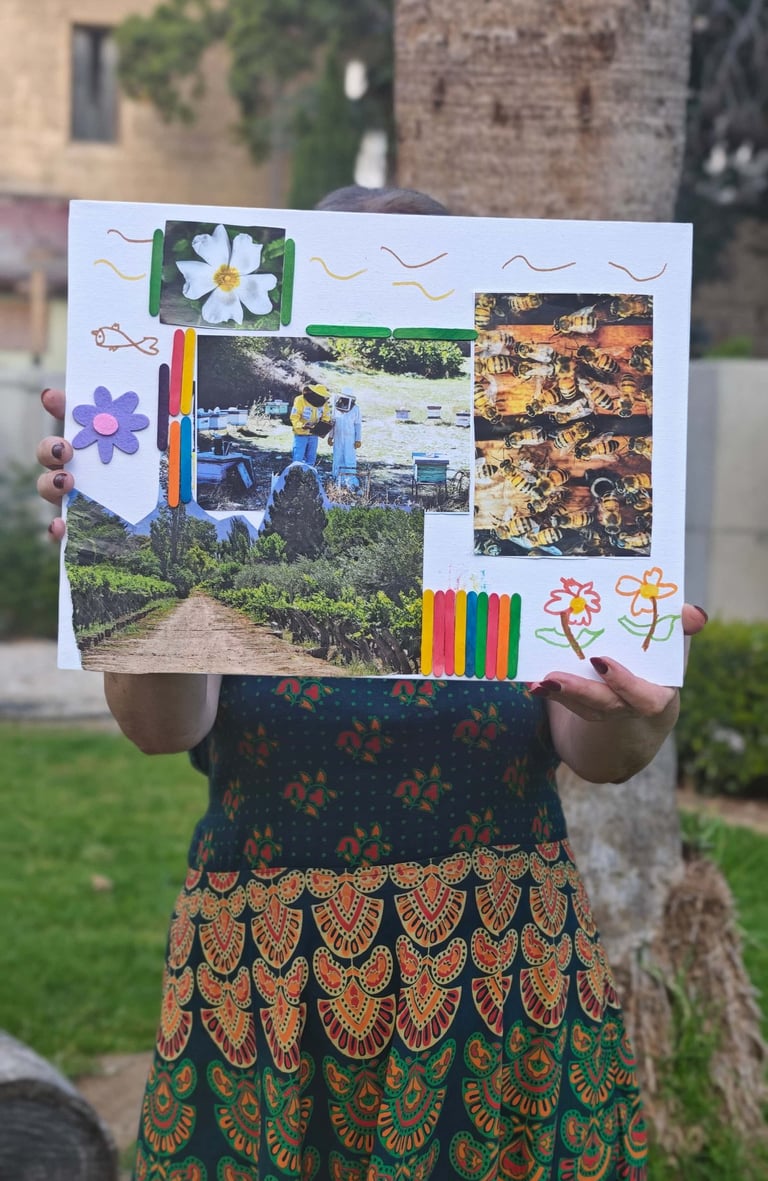
Look at what she chose to put on the page. Beekeepers in their pale suits, working among the hives in a field so green it could only be the north. A close panel of honeycomb, golden and dense with bees. A dirt path running between orchards and vines. A single white wild rose. These are not random images. They are Mazandaran, the lush green province on Iran's Caspian coast where Romine is from, reassembled by hand in a city far away.
HERS
Funded by the European Union. Views and opinions expressed are however those of the author(s) only and do not necessarily reflect those of the European Union or the European Education and Culture Executive Agency (EACEA). Neither the European Union nor EACEA can be held responsible for them.
Contact
hers@odyssea.com
© 2024. All rights reserved.